
GOVERNMENT SERVICES
🇭🇳 BIEN Honduras Wallet
Exploring how trusted digital identity can connect citizens to government benefits, financial services, and everyday payments.
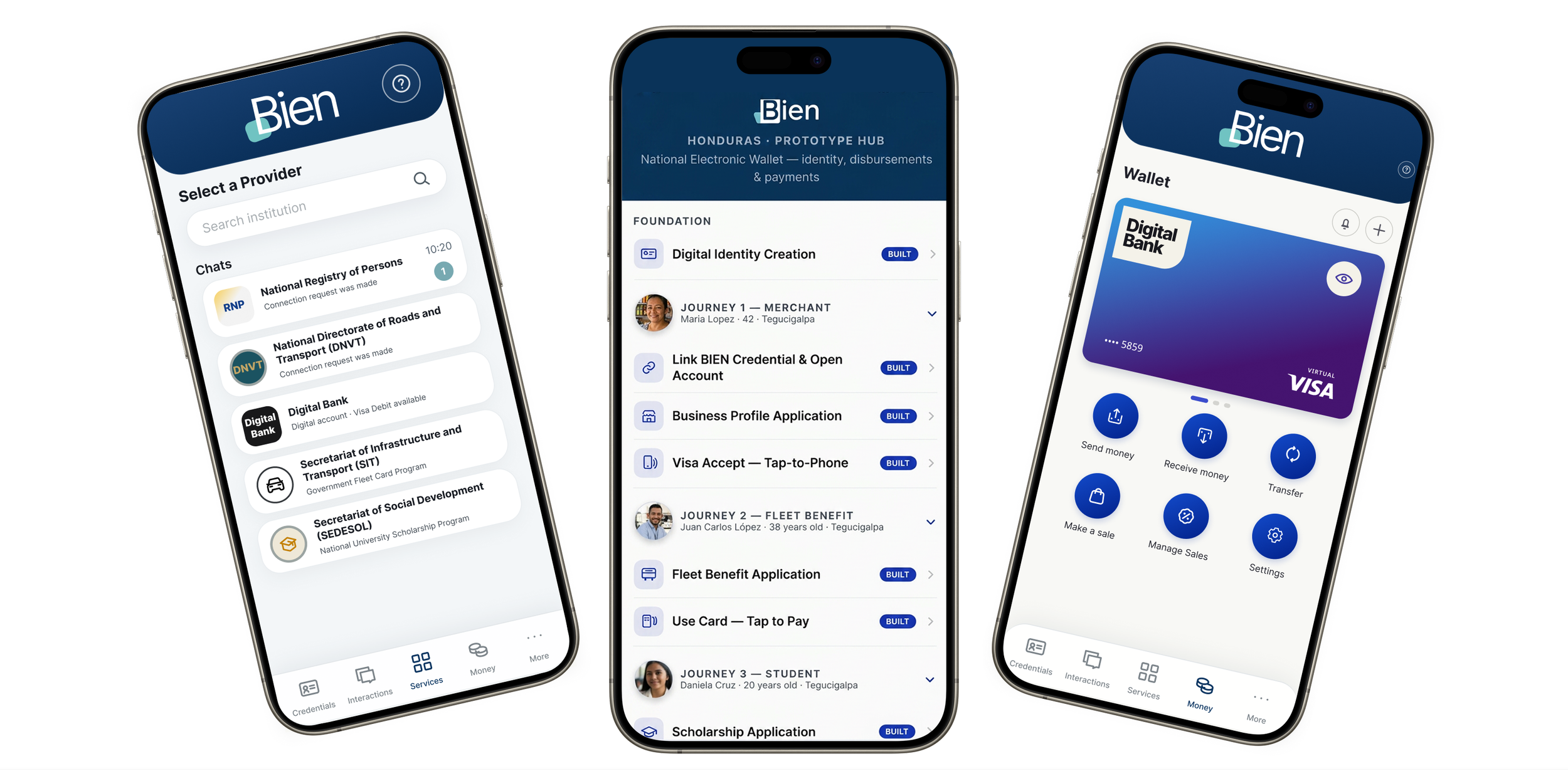
Focus: Digital Identity • Financial Inclusion • Government Benefits • Payments
My role: Sr. Staff Product Designer
Partners: Solution architects • Product Pre-Sales
• Government stakeholders
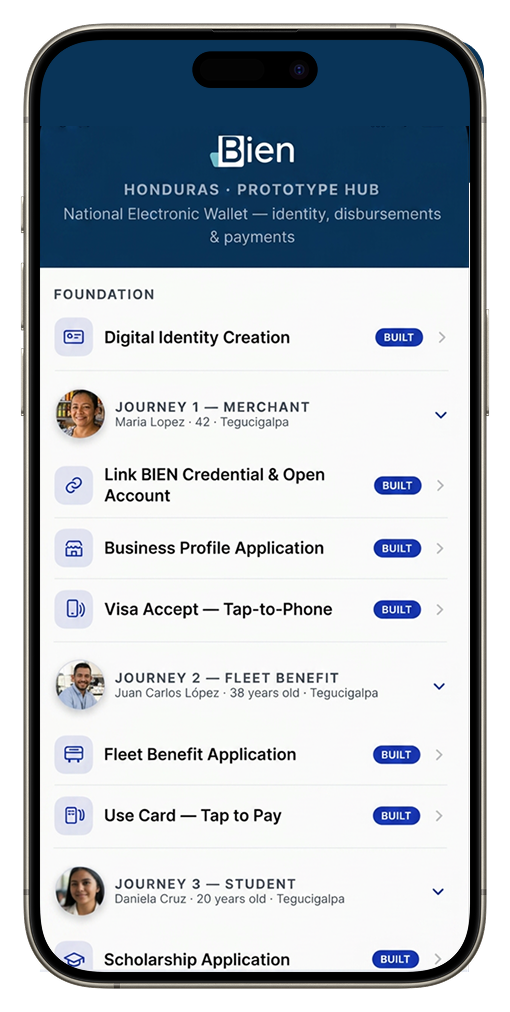
From identity to financial utility
BIEN, Honduras's national electronic wallet initiative, provides the foundation for trusted digital identity.
This project explored how that foundation could extend beyond identity verification into financial services, government benefits, and everyday payments.
The opportunity
Build on an existing digital identity ecosystem rather than creating another disconnected service.
By connecting identity, credentials, and payment capabilities, we could explore how different citizens might access financial services through one familiar experience.
From platform capabilities to citizen experiences
My focus was exploring how reusable identity and payment capabilities could support different services and citizen needs.
The approach connected three perspectives:
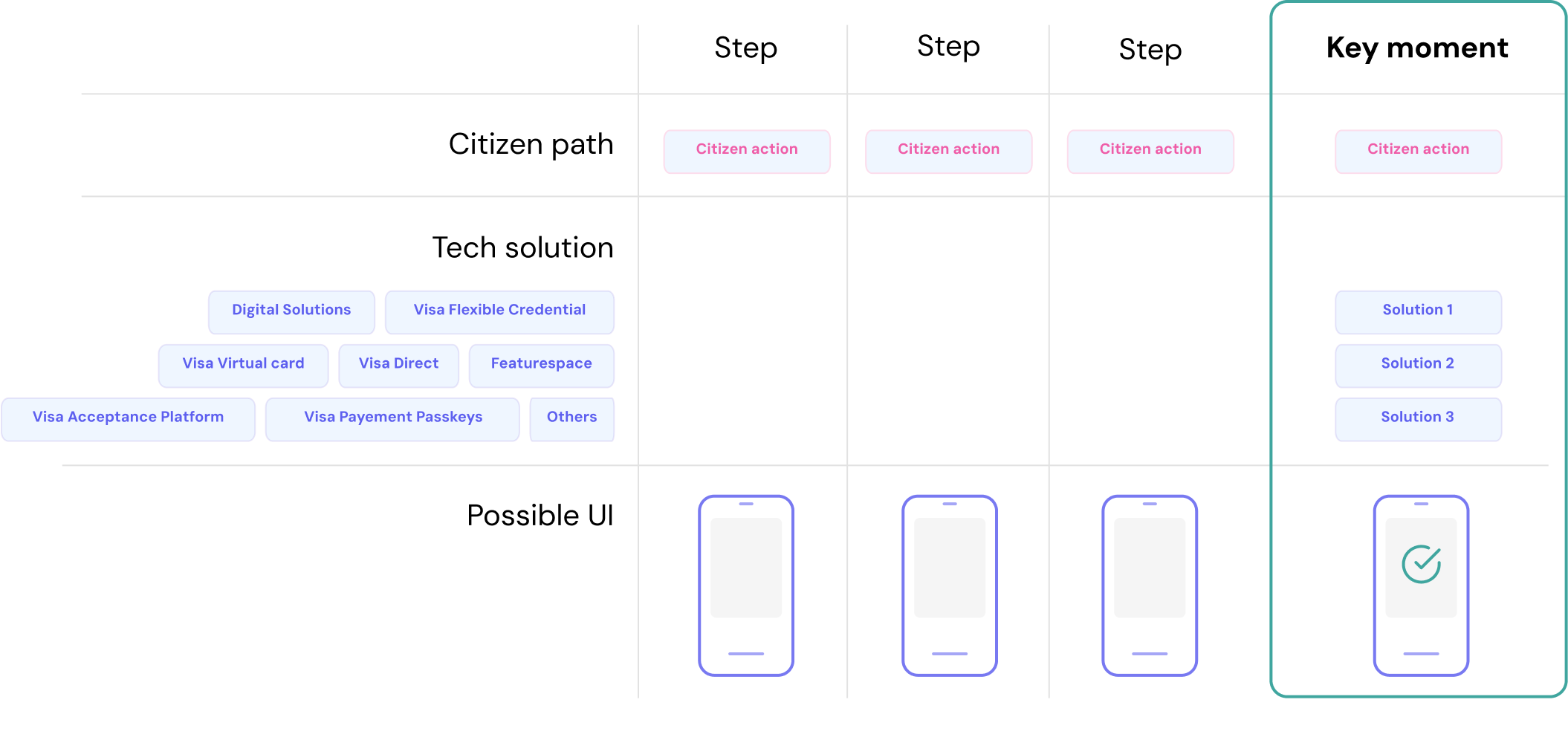
Citizen path
Understanding the needs and goals of different users.
Technology solution
Connecting identity, authentication, consent, credentials, benefits, and payments.
Possible UI
Turning the proposed services into interactive journeys using Claude Code.
Why it matters
The same technology foundation could support very different experiences, from receiving financial assistance to running a small business.
Bringing the experience to life
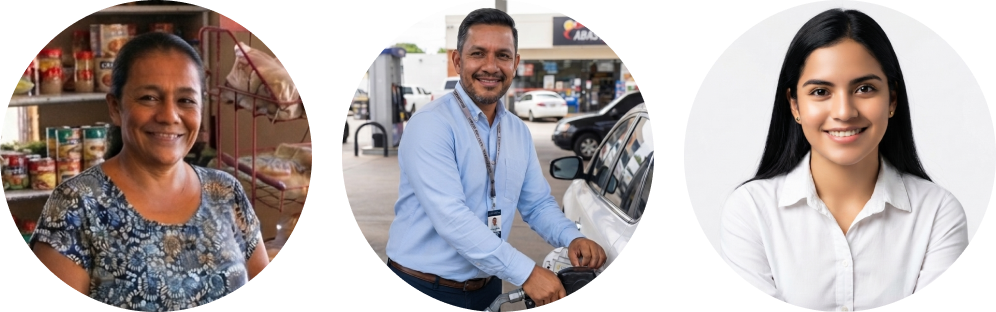
Three personas, one wallet
To demonstrate how the platform could support different financial needs, I explored three scenarios in Honduras:
María López, 42 — Small Business Owner
A corner shop owner in Tegucigalpa who wants to establish a merchant account and accept digital payments.
Juan Carlos López, 38 — Fleet Benefit Applicant
A fleet benefit applicant who needs to access financial support for fuel, tolls, maintenance, and other business expenses.
Daniela Cruz, 20 — University Student
A student applying for scholarship assistance to support her education.
Each journey begins with a shared digital identity foundation before branching into a specific financial service.
The experience
From journey to working prototype

Exploring future-state services with Claude Code
I used Claude Code to develop an interactive prototype that brought together digital identity creation, merchant services, fleet benefits, and student assistance.
The prototype helped me explore how different experiences could connect through shared capabilities, while accelerating the transition from journey mapping to functional interactions.
This was scenario-based future-state exploration, illustrating what BIEN could potentially enable rather than representing existing production capabilities.
01. Onboarding to the Wallet
Before accessing financial services, citizens establish their digital identity and securely connect it to BIEN Wallet.
The experience creates a trusted foundation that can be reused across government benefits, financial services, and payments.
The journey
Get started: Discover BIEN Wallet and its available services.
Create an account: Establish secure access to the wallet.
Verify identity: Create or connect a trusted BIEN digital identity.
Set up biometrics: Enable secure authentication for future interactions.
Access the wallet: Explore available government and financial services.
Design consideration: Make onboarding simple and trustworthy while creating a reusable foundation for different citizen journeys.
02. Small Business Owner — From Identity to Payment Acceptance
María uses her BIEN identity to open a financial account and set up her business.
She shares her verified information with consent, completes the application, and establishes a merchant profile.
Once approved, María can use Tap to Phone to accept contactless payments directly from her smartphone.
Design consideration: Reduce repetitive verification and simplify access to business services by reusing trusted identity credentials.
03. Fleet Benefit — From Eligibility to Everyday Use
Juan explores the Fleet Benefit program through BIEN Wallet.
He shares the required credentials, verifies his identity, and submits his application.
Once approved, he receives a virtual Visa card containing his monthly benefit, which he can use for fuel, tolls, maintenance, and other eligible expenses.
Design consideration: Connect benefit eligibility, approval, disbursement, and spending into one understandable journey.
04. Student Aid — From Scholarship to Financial Support
Daniela discovers a scholarship opportunity through BIEN Wallet.
Using her existing identity, she shares the required credentials, verifies her university enrollment, and completes her application.
Once approved, the scholarship funds become available through her wallet, where she can access the balance or transfer money.
Design consideration: Reduce repeated verification while making scholarship applications and financial support easier for students to access.
Designing for reuse and flexibility
The experience was built around three connected layers:
Shared foundation
Digital identity, authentication, consent, and reusable credentials.
Service layer
Government benefits, merchant services, and scholarships.
Financial layer
Account opening, disbursements, virtual cards, and payment acceptance.
Rather than designing separate systems for each use case, the concept explored how reusable capabilities could support multiple citizen journeys.
The outcome
Same foundation, different outcomes
The BIEN concept demonstrated how one digital identity foundation could support multiple financial experiences without requiring a separate solution for every service.
Across the four journeys, the work illustrated how shared capabilities could:
Extend trusted digital identity into financial services.
Connect government benefits with everyday payments.
Reuse authentication, consent, and credentials across different journeys.
Support multiple citizen needs through one adaptable platform.
For me, the project reinforced the value of designing reusable platforms around real citizen needs while using AI-assisted development to bring those possibilities to life.